

Water within hospitals isn’t just a basic need; it is critical to patient care and to serve vital areas of hospitals that deal with surgery, sterilisation, laboratory testing, and food preparation.
Therefore, the protection of the water system is vital to serving the most vulnerable patients, which puts more emphasis on ensuring that the water supply entering the building is safe and free of contaminates.
How is this achieved using a Point of Entry Filter (POEF)?
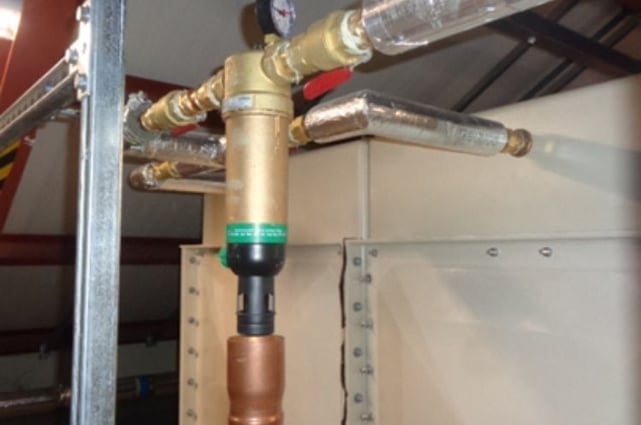
The POEF is a mechanical device (see photograph above) devised to filter out particulates and bacteria that may be present within the incoming mains supply to a building.
These filters are very different from those point-of-use filters fitted on outlets; the POEF provides protection to the whole of the building’s water system.

How do Point of Entry Filters work?
Filtration of particulates and bacteria reduces colonisation from NTM (non-tuberculous mycobacteria) and other waterborne pathogens, including those which may be resistant to disinfection and pasteurisation through heat and chemicals, which puts the water system at risk.
At what stage are POEFs introduced?
The prevention of allowing NTMs into the hospital system, especially to areas occupied by immunosuppressed patients, is of paramount importance.
The introduction of the POEF should be considered by the Project Water Safety Group and Building Project Team and then implemented as part of the project design review process.
What should the Water Safety Group consider?
Consideration should be given to:
- The type.
- Specification.
- Cost of POEF should be considered at design, along with the cost of continued maintenance of the POEF over its life expectancy.
The design should provide for duplicate filters in parallel, so as to avoid the need for the filter to be bypassed during maintenance.
The type of POEF to be fitted is vital, as selecting a type that requires the filter to be changed must be avoided, as this practice presents a risk of contamination. Therefore, the POEF specifications that are described in NETB, Page 36 should be;
- a back-washable type
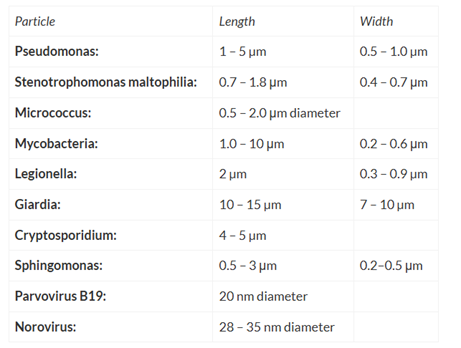
- capable of achieving sterilising-grade performance. Sterilising grade is described as typically 0.2micron to achieve ‘absolute filtration’, thus meaning that at 0.2 microns the pore size meets the requirements to retain the NTM and other waterborne pathogens.
To demonstrate why a filter of 0.2 microns is required, is shown in the table below which provides statistical information on the pathogens found within the water system.
Installation and competence
 How and who installs the POEF must also be considered. Due to the nature of what the filter does, and the filter being that first line of defence to the hospital water system, the filter must be installed, commissioned, and operated without risk of becoming contaminated. It must be ensured that evidence of contractor competence is provided to the Water Safety Group, and this evidence is readily available when requested as part of any audit or Legionella risk assessment.
At the construction stage of a new build or major refurbishment project, it is vitally important that the POEF is not bypassed during flushing or filling the domestic water systems. All water must pass through the filtration system, from when the system is first wetted.
So, you have got the POEF fitted, what next?
The POEF must undergo routine maintenance, an SOP (Standard Operating Procedure) and PPM (Planned Preventive Maintenance) regime for the filter, to be added to your Legionella Written Scheme of Control and Water Safety Plan.
Upon updating the Water Safety Plan, ensure that the frequency of the maintenance tasks is agreed.
There are various manufacturers of point-of-entry filters, and the guidance may vary depending on the make, but consideration should be given to the following.
- Flush every two months, to ensure that biofilm doesn’t develop within the filter, otherwise the filter will become the exact opposite of what it was designed and fitted to do.
- Every six months, remove the filter mesh and clean. If it’s seen that the filter is damaged or clogged, replace the filter.
Ensure that the personnel conducting this task have been trained and are competent in performing this task, and that the actions of this ongoing maintenance are recorded.
Feel free to reach out if you have any questions about the issues mentioned above or if you would like to consult with one of our experts on water hygiene.
Editor's Note: The information provided in this blog is correct as of the date of original publication – April 2026
© Water Hygiene Centre 2026