

Legionella risk assessments are a fundamental part of managing water safety, helping organisations understand and control the risks associated with Legionella bacteria within their water systems.
However, a risk assessment is not simply a document to file away and forget. A good Legionella risk assessment provides a clear understanding of where risks exist, what controls are required, and whether your current water management arrangements are effective.

Why do you need a Legionella Risk Assessment?
Legionella bacteria can naturally occur in water systems, but under the right conditions — such as water temperatures that allow growth, areas of stagnation, inadequate maintenance, or poor system design — they can multiply and create a risk of exposure.
When contaminated water droplets are inhaled, Legionella can cause serious illness, including Legionnaires’ disease, a potentially fatal form of pneumonia.
UK health and safety guidance, including the Health and Safety Executive’s Approved Code of Practice L8 (ACoP L8), places a legal duty on organisations to identify and manage the risks associated with Legionella.
A suitable and sufficient Legionella risk assessment is the starting point for demonstrating that these risks are being properly controlled. A quality risk assessment should help you to:
- Identify potential sources of Legionella risk within your water systems
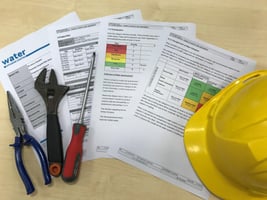
- Understand how your systems operate and whether they are adequately controlled whilst factoring in the susceptibility of the user.
- Highlight areas requiring improvement or further investigation
- Ensure your written scheme and control measures are appropriate
- Provide assurance to those responsible for water safety
- Highlight possible requirements or gaps for training needs
- Detail information on hierarchy of control
- Give you the information needed to update current control documents.
- Understand the water system visually using accurate schematics.
Protect your organisation and your water users
A Legionella risk assessment is more than a compliance requirement — it is an essential tool in protecting people, reducing risk, and ensuring your water systems are managed effectively.
Choosing the right provider is just as important as having the assessment completed. With UKAS accreditation, experienced consultants, and a practical approach to water safety, we can help you understand your risks and help guide you with effective control measures.
If you need confidence that your Legionella risk assessment is providing theassurances you need, speak to our team today
How we can help
Our team of experienced water safety consultants provides independent, expert Legionella risk assessments across a wide range of sectors, including healthcare, education, commercial buildings, housing, and public sector organisations.
We take the time to understand your building, your water systems, and your specific challenges. Our approach combines technical expertise with practical recommendations, helping you make informed decisions about your water safety responsibilities.
Whether you need a new Legionella risk assessment, a review of an existing assessment, or support understanding how to address identified risks, we can provide the guidance and assurance you need.
Not all Legionella Risk Assessments are the same
While many organisations offer Legionella risk assessments, the quality, depth and expertise behind them can vary significantly.
A risk assessment should go beyond simply ticking boxes. It requires technical understanding of water systems, legislation, guidance, and the practical challenges faced by those responsible for managing buildings.
An effective assessment should consider factors such as:
- System design and configuration
- Hot and cold water storage and distribution
- Associated systems
- Primary or secondary control measures such as temperatures or biocide
- Areas of stagnation or low use
- Management and training responsibilities
- Maintenance and monitoring arrangements
- Building occupancy and vulnerability of users
- Historical issues and future changes to the building
The outcome should be clear, practical advice that helps you reduce risk — not just a report that identifies problems without providing solutions.
UKAS Accredited Legionella Risk Assessments
 Quality and competence matter when it comes to assessing Legionella risk.
We are proud to be one of only 14 companies in the UK to hold UKAS accreditation for Legionella risk assessments. This recognised accreditation provides confidence that our assessment processes, technical competence, and quality management systems have been independently assessed and meet rigorous standards.
For our clients, this means additional assurance that their Legionella risk assessment is being completed by a competent organisation operating to recognised benchmarks.
If you would like further help and advice on your Legionella Risk Assessments, contact us today, and we'll be happy to help.
Editor's Note: The information provided in this blog is correct as of the date of original publication – July 2026.
© Water Hygiene Centre 2026