

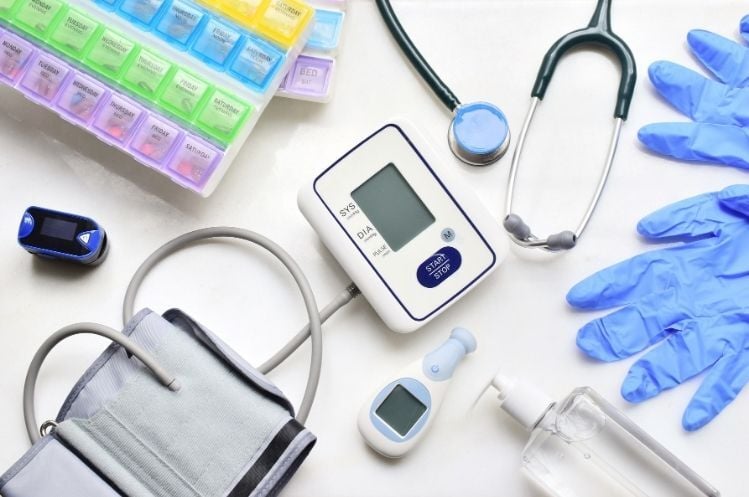
A healthcare premises is defined as any building, structure, or vehicle where, or from which, services for the maintenance, improvement, or restoration of health are provided. The care received should not be compromised by other unique risks, such as those from water.
Healthcare Water Safety Standards – where are they applicable?
Any facility, clinical or non-clinical, that forms part of a wider healthcare facility or NHS site is subject to the 2016 edition of Health Technical Memorandum HTM04-01, which reflected the updated version of ACoP L8 and its associated HSG274 guidance documents. The concepts of Water Safety Groups (WSGs) and Water Safety Plans (WSPs) were introduced, and these are there to include the wider aspects of non-clinical facilities and the associated water systems.

However, water system designs will vary to reflect the operational risk. Accurate design, through a detailed holistic design risk assessment that factors in the user's actual susceptibility to illness, should bring appropriate elimination or control of the hazards to reduce the risk.
NHS Estates Technical Bulletin (NETB) No.2024/3 was issued in August 2024 with the objective of enhancing the existing HTM04-01 guidance, focusing on the patients at greatest risk of healthcare-associated infections.
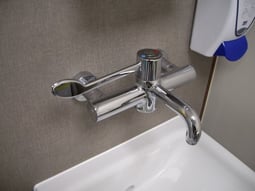 Other facilities that support clinical services can offer reduced risks and can present opportunities to be ‘rational’ with the selection and operation of plant and equipment. The correct risk assessment can also reduce capital and operational expenditure whilst resulting in improvements to energy sustainability. An example is an administrative building that, via the scald risk assessment, might determine that thermostatic control of hot water outlets to general-staff-only hand wash basins can be avoided, leading to thermostatic control only being required in accessible WCs.
Should there be proposed derogations from a Trust’s Water Safety Plan, they should be demonstrated on an informed basis and signed off by the Trust’s Water Safety Group.
Design and Operational Specifics for Healthcare Water Systems
Due to the diverse and varied nature of healthcare facilities, the design and operation of water systems are required to control bacterial and scald risks, but also support business continuity, therefore needing resilience/back-up.
 For example, a clinical facility that operates 24 hours/365 days requires a continuous supply of water, which introduces storage tanks. As tanks need to be inspected and sometimes cleaned, requiring isolation, there needs to be more than one tank/section to allow the maintenance to be delivered. This, in turn, can bring excessive storage, leading to lower turnover/stagnation. Therefore, it is imperative that the selection of new plant and equipment is based on the actual water demand and usage is monitored regularly to give assurance that the design reflects the operational needs and control.
Water Safety Groups (WSGs)
“The Health and Social Care Act 2008: Code of Practice on the Prevention and control of Infections and related guidance” requires a Water Safety Group and Water Safety Plan to be in place to manage and monitor the prevention and control of infections effectively.
Therefore, the duty holder should appoint a WSG to deliver on the development, implementation, and continuous review of a WSP. In turn, the WSG should have clear lines of accountability (communication pathways) to the CEO and the Board.
Project Water Safety Groups (PWSGs)
A PWSG has a similar purpose and requirement to that of an organisation’s WSG, but specifically to manage water safety for construction projects.
The Construction (Design and Management) Regulations 2015 require that commercial clients appoint other duty holders as appropriate, which can be more than one individual, to manage a project. ACoP L8 requires the duty holder to appoint a Responsible Person, and this applies to projects too. The roles and responsibilities are to look at the specific risks related to the specific project and report to the wider WSG.
Feel free to reach out if you have any questions about the issues mentioned above or if you would like to consult with one of our experts on water hygiene.
Editor's Note: The information provided in this blog is correct as of the date of original publication – March 2026
© Water Hygiene Centre 2026