

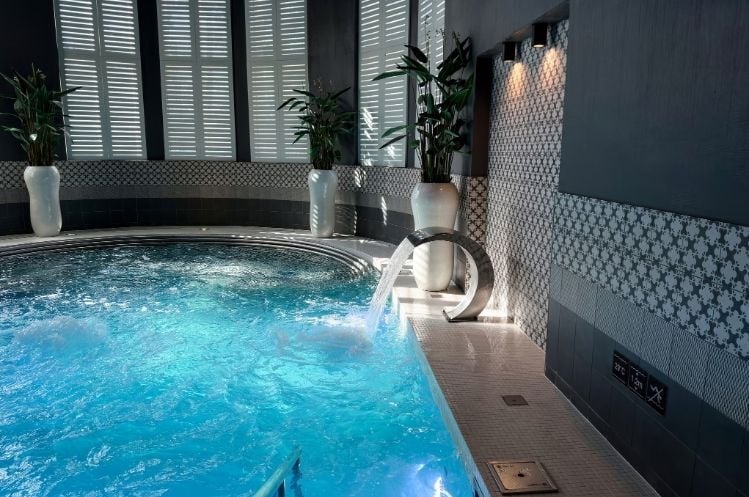
In a domestic / leisure setting, spa pools bring the appeal of an accessible escape from daily stress and in a healthcare setting, they can bring rehabilitation, therapeutic exercise and pain management.
Research shows that spa pools can offer a range of benefits, including:
- Physical health and wellness benefits
- Mental relaxation and stress relief
- Social and lifestyle enhancements
- Property and convenience value.

What is a Spa Pool?
Spa pools come in many designs, each tailored to its intended use. However, the common aspect is that a spa pool is a self-contained body of water held between 30 °C and 40 °C and agitated and circulated using air-jets, sometimes with air-induction bubbles.
The Pros and Cons of Spa Pools
 Spa pools are wonderfully relaxing and offer many benefits, but improper maintenance can pose serious health risks. With water temperatures usually between 30°C and 40°C, they provide a perfect environment for bacteria, including Legionella, to grow. Features like air jets and bubbles can create tiny droplets that may be inhaled, so good operation and hygiene are essential to keep your spa experience safe.
The illnesses can be categorised as:
- Respiratory illnesses, e.g. Legionnaires’ disease, Pontiac fever, Hot tub lung, chlorine-induced lung injury.
- Skin and wound infections, e.g. Pseudomonas folliculitis, hot-foot syndrome, cellulitis, green nail syndrome.
- Gastrointestinal Illnesses e.g. diarrhoea, stomach cramps, nausea, vomiting, fatigue.
- Others – Urinary tract infection, eye and earinfection, nausea.
Are you aware of the HSE Guidance HSG282?
Following several reported illnesses, the UK Health and Safety Executive (HSE) developed HSG282, the recognised best-practice guidance for “The control of Legionella and other infectious agents in spa-pool systems.” Although it is not legally binding, HSG282 is widely accepted as the standard for helping operators comply with the Health and Safety at Work etc. Act 1974.
HSG282 primarily focuses on commercial spa-pool systems, but it also provides advice for domestic-style systems, such as those found in holiday homes, leisure centres, cruise ships, hotels, and display pools.
Even though privately owned spas and hot tubs aren’t legally bound by HSG282, following the guidance and the manufacturer’s instructions is a smart way to keep yourself, family, and friends safe. The guidance is also easy to access and free to download, making it simple to keep up with bestpractices.
Legal hierarchy.
HSG282 forms part of the legal hierarchy that governs the control of substances hazardous to health:
- Health and Safety at Work etc. Act 1974
- Management of Health and Safety at WorkRegulations 1999
- COSHH Regulations 1992
- ACoP L8 – The control of legionella bacteria in water systems
- HSG274 – Part 3: The control of legionellabacteria in other risk systems.
- HSG282 – The control of legionella and other infectious agents in spa-pool systems’
The guidance comes from the Health and Safety Executive and isn’t legally required unless explicitly stated, so you do have the flexibility to take alternative measures if needed. However, following HSG282 is generally accepted as demonstrating sufficient compliance with the law, and Authorising Engineers (Water) recommend adhering to it.
HSG282 Key focuspoints.
The guide outlines practical ways to manage these systems safely and effectively, including:
- Project Water Safety Design – factors to consider in the design are location, bather load, source water quality, draining and refilling, cleaning and maintenance access, balance tank, plant location, filtration, chemical treatment and storage, circulation and turnover rates, construction materials and prevention of dead-legs.
- Commissioning – considers risks from residual water from manufacturer pressure testing, functional safety check, fit for the intended use, disinfection, chemical and bacteriological analysis and full operational functionality test.
- Operation and maintenance – The guidance focuses on keeping spa pools clean and hygienic, from regular surface cleaning to completely dismantling components for a thorough deep clean.
- User hygiene – The guidance advises of appropriate user procedures, which include user hygiene. To help maintain water quality, users should use the toilet and shower before entering the pool and not wear suntan lotions, spray tans or skin creams or similar.
- Testing and monitoring water quality – to demonstrate that the maintenance regimes are maintaining the required water quality, the guidance advises routine sampling and testing for the presence of bacteria.
Record keeping.
Keeping clear records is essential for demonstrating compliance. You should document:
 Legionella Risk Assessment that’s tailored to your spa pool, who uses it, and how often it’s in use.
- The spa pool’s manufacturer details and full technical specifications.
- Evidence that installation, commissioning, and “setting to work” were carried out according to the manufacturer’s instructions.
- A Legionella written scheme of control and maintenance is present to make clear the required maintenance tasks, frequencies and who is responsible, including the dutyholder and the responsible person.
- The tasks given in the written scheme are carried out by competent people.
- Maintenance records are kept confirming who carried out which maintenance task, the date it was undertaken and what materials/chemicals were used.
> Further Reading: How to manage Legionella risk in Spa Pools
Feel free to reach out if you have any questions about the issues mentioned above or if you would like to consult with one of our experts on water hygiene.
Editor's Note: The information provided in this blog iscorrect as of the date of original publication – February 2026
© Water Hygiene Centre 2026