
The environment is something we should all be concerned about. It’s not just about the trees and the air, it’s about the future survival of our planet. There is no ‘Planet B’. That means making significant changes in the way we conduct our lives and go about our day-to-day living.
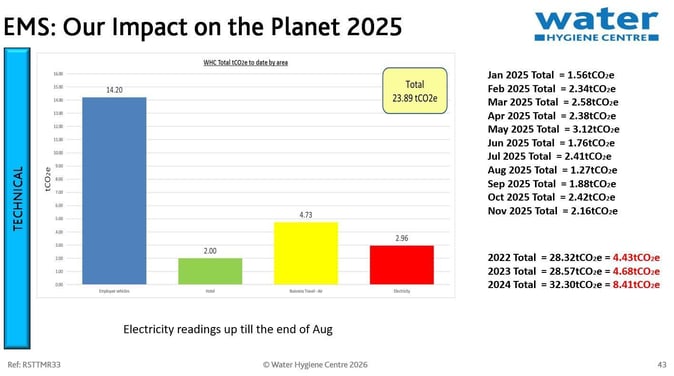
In 2025, we cut our carbon footprint by an impressive 8 tCO₂e compared to 2024 — a clear result of the positive changes we’ve made as a business.
Climate change refers to a broad range of environmental degradation as a result of increasing levels of atmospheric CO2. The main component of climate change is global warming, which is largely attributed to human activity like the burning of fossil fuels (i.e., earth's limited natural resources, gas, oil, and coal).

Another main contributor is emissions of greenhouse gases like CO2, which, as a business, the Water Hygiene Centre monitors how much we contribute and understands how we can reduce our CO2.
The Water Hygiene Centre: What we have learned
To understand what the current Carbon Footprint is for the Water Hygiene Centre, we needed to learn what it was that we could monitor, how to obtain that information, and then establish baseline data, so we could look to improve.
Our learning is from the Greenhouse Gas Protocol, which defines two scopes:
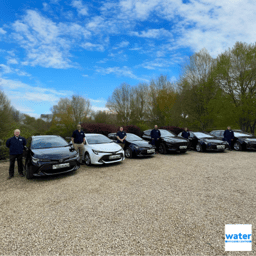 Scope 1 - direct emissions from the business or under their control, such as fuel usage from manufacturing, gas boilers, fleet vehicles, and air-conditioning leaks.
- Scope 2 - indirect emissions from your energy supplier, so switching may save approx. 25% of your carbon footprint straight away.
In 2022, we started to establish our baseline ‘damage data’. We focused on the four main areas of scopes 1 & 2, being:
- Vehicle emissions
- Business travel
- Hotel stays
- Office electricity
We were able to collect data monthly, and using Government supplied Greenhouse Gas reporting conversion factors, we were able to convert this to a tCO2e.
How could we improve our Carbon Footprint?
This data was shared at our monthly Team Meeting, where we sought feedback from the team on how we could reduce our output, one of the ideas being changing company vehicles to Hybrid and electric.
At the end of 2022, with all our Carbon footprint data collated, we started thinking about how we could offset our operational carbon emissions to commit to becoming carbon neutral for that year. This is where our journey with Beyond Procurement began…
The first part of the journey was to commit to becoming carbon net zero. With all of our energy usage and carbon footprint data, we worked with Beyond Procurement to create a net-zero pathway and strategy that looked at carbon reduction actions and how we could refine our activities for future reductions.
Our Solution and Outcome
Although 2022 was over, with our carbon footprint data to hand, we asked Beyond Procurement whether there were opportunities to turn this insight into immediate, meaningful improvements. This collaboration is discussed in more detail in our YouTube podcast with Beyond Procurement, where we explore the practical steps we took and the thinking behind them.
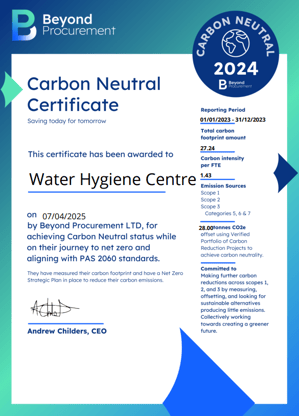 They proposed several initiatives to help us offset our final tCO₂e for that year, including a range of verified carbon reduction projects. Ultimately, we chose a tree-planting project in the south-east of the UK — a solution that was both impactful and local to our area.
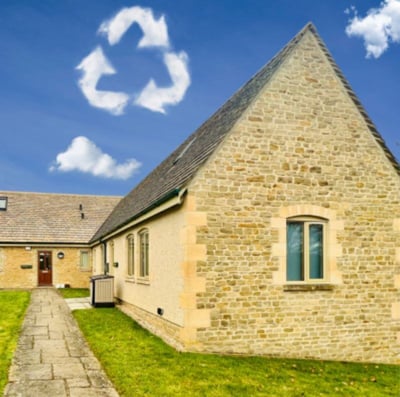
We are proud to say that since 2022, the Water Hygiene Centre has been certified as Carbon Neutral. Our journey continues as we implement further environmental strategies, including ride-sharing, increased use of public transport, and the installation of LED lighting across our office.
An 8 tCO₂e reduction in 2025 — proof that our sustainability commitments are working
Climate change is a reality we all must face. It will continue to have a profound impact on all life on Earth. We need to act now if we want to leave a livable planet for future generations.
Read more and visit our Environmental and Social Responsibility page.
Feel free to reach out if you have any questions about the issues mentioned above or if you would like to consult with one of our experts on water hygiene.
Editor's Note: The information provided in this blog is correct as of the date of original publication – October 2023
© Water Hygiene Centre 2023