


Schools, Colleges and Universities bring a diverse mixture of water-based systems, some of which can be subject to seasonal changes, bringing different risks. Whether it be a water feature, a staff kitchenette, an outside tap, a hall of residence or a complex laboratory building, there is a legal responsibility to operate and manage each water system in ways that are specific to the certain operational characteristics of each type of facility.
Legal Requirements - Water Hygiene in Schools and Universities
The current legislation for the United Kingdom is:
- Health and Safety at Work etc. Act 1974
- Management of Health and Safety at Work Regulations 1999
- Control of Substances Hazardous to Health Regulations 2002 (COSHH)
By following the guidance of the HSE Approved Code of Practice (ACoP L8) – Legionnaires’ disease – The control of Legionella bacteria in water systems and its supporting technical guidance (HSG274), you should adequately control the Legionella hazard within your water systems, bringing you into compliance.
What is Legionnaires’ Disease?
 Legionnaires’ disease is a potentially fatal form of pneumonia contracted by inhaling small droplets of water (aerosols) that contain Legionella bacteria, which exist naturally in fresh water, e.g. rivers and ponds.
Illness occurs from exposure to Legionella bacteria growing in purpose-built water systems where certain conditions encourage growth. These conditions are:
- The water temperature in all or some parts of the system may be between 20-45 °C;
- It is possible for water droplets to be produced and dispersed;
- Water is stored and/or recirculated;
- There are deposits that can support bacterial growth, providing a source of nutrients for the organism, such as rust, sludge, scale and organic matter.
Key Factors Affecting Legionella Risk in Educational Settings
Having a mixed property portfolio requires a structured approach so that higher-risk aspects can be given greater attention. Although all water systems need to be operated and managed compliantly, the Health and Safety Executive refers to ‘as low as reasonably practicable’ (ALARP). The HSE’s definition of ALARP is “relevant good practice”, which is determined as part of the risk assessment process.
Factors to consider and examples are:
- Susceptibility of the users – the elderly, young and immunocompromised could have access to public sports/leisure facilities, there may be a creche/nursery where scalding is another risk, likewise if student accommodation is used for alternate use outside of term time;
 Occupancy levels/usage patterns – low occupancy, teaching patterns and holidays naturally bring reduced usage, which requires weekly usage evaluation and, where necessary, Legionella flushing regimes. Equally, be mindful that handing facilities over to a project team (e.g. for decoration) brings changes that require a change to the management regime;
- Access restraints – planned and preventative maintenance (PPM) and routine monitoring could be affected through controlled/restricted areas that require a permit to work, e.g. plant rooms or laboratories;
- Stored water – stored water, e.g. cold-water tanks and hot water cylinders, offer characteristics that can support the build-up of sediment/scale. Also, maintaining the correct temperature can be affected depending on configuration, location and usage/turnover;
- Appliances that generate aerosol – as the route of infection is through inhalation, it is important to know where high-risk outlets/equipment are, e.g. cooling towers, spa pools, evaporative coolers, showers, spray taps, etc. In university research, there are often unique water systems, e.g. mimicking rainforest or marine environments. Laboratories may have water baths, deluge showers, etc which need to be identified and risk assessed. Responsibilities for such equipment may lie within the academic departments rather than with Estates.
Using a Checklist to Manage Hot and Cold-Water Systems
- Legionella Risk Assessment (a legal requirement).
-
- Consider if any risk could be eliminated, e.g. remove storage;
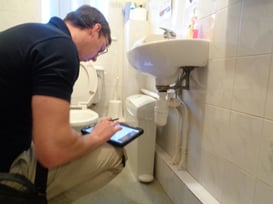
- The risk assessor should demonstrate they have the correct competency for the system they are assessing and that their report is adequately accredited;
- Consult employees about the risk assessment and control measures;
- Agree on a review date and/or reasons that would require a review.
- Consider if any risk could be eliminated, e.g. remove storage;
- Management, training and responsibility:
-
- The ‘duty holder’ should appoint in writing a ‘responsible person’ and ‘deputy responsible person’, with contact details being readily available;
 The roles and responsibilities of all the staff/contractors involved in the maintenance and operation of the water system should be defined in writing;
- Provide the appropriate Legionella training to the responsible internal staff and check the competencies of contractor staff;
- Raise awareness of relevant staff and students on symptoms and prevention;
- Encourage reporting of faults and poor conditions.
- The ‘duty holder’ should appoint in writing a ‘responsible person’ and ‘deputy responsible person’, with contact details being readily available;
- Operation and Maintenance checks.
-
- If the water supply is pre-treated, check that it achieves the same microbiological quality as mains cold water;
- Hot water cylinders are maintained at 60 °C for at least an hour each day, e.g. via a destratification/shunt pump;
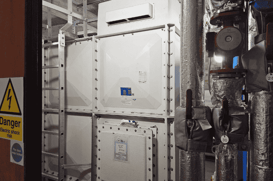 Hot water cylinders inspected for sludge/scale build-up;
- Cold water tanks are routinely inspected and cleaned if necessary;
- Unused outlets are removed and pipework cut-back at the live main, removing the dead-legs;
- Standby equipment is routinely changed to ‘duty’ operation;
- Expansion vessels are flushed and purged;
- Low-use outlets to be removed or flushed at least weekly;
- Thermostatic mixing valves are included in the PPM schedule;
- Be careful when using chemical water treatment methods by undertaking an assessment of risks to people, materials and processes. For example, there is a potential risk of jeopardising the routine and research activities of biological science and medical departments due to the presence of biocides.
- If the water supply is pre-treated, check that it achieves the same microbiological quality as mains cold water;
- Monitoring
-
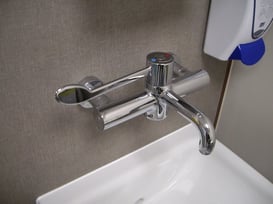 The temperature of hot and cold water should be taken monthly at the sentinel points and at a representative number of other outlets;
- Thermostatically controlled outlets should have the temperature checked routinely to prevent scalding;
- Physical condition of all fittings, plant and equipment should be routinely checked to maintain good condition and working order;
- Asset registers in conjunction with schematic and plan drawings should be checked and updated to maintain accuracy.
Using your checklist will inform your individual Legionella written control scheme requirements.
Further information can be downloaded from the following links.
https://www.hse.gov.uk/pubns/books/l8.htm
https://www.hse.gov.uk/pubns/books/hsg274.htm
Engaging Professionals for Water Safety Compliance
Engaging with an independent professional Legionella consultant or Authorising Engineer (Water), who can provide guidance on best practices, thorough inspections and water safety audits that are tailored to your specific needs, can help you comply with legislation.
Feel free to reach out if you have any questions about the issues mentioned above or if you would like to consult with one of our experts on water hygiene.
Editor's Note: The information provided in this blog is correct as of the date of original publication – January 2026
© Water Hygiene Centre 2026