
If you are responsible for estate or building management in your hospital or healthcare setting, you are invariably responsible for appointing a water safety consultancy to complete your Legionella risk assessments.
As such, you’d be mindful of the importance of water safety and getting it right. The effective management of water systems is vital to prevent Legionnaires' disease, a waterborne pathogen typically transmitted via atomised water.
Here, we examine some key points to bear in mind and, in particular, how to choose the right consultants for the job, minimising the risks and achieving effective risk management.
ACoP L8 and BS8580-1 Water Quality Risk Assessments for Legionella
ACoP L8 offers practical advice and specific guidance on the control of Legionella bacteria in water systems, and it applies to all organisations. Key elements include ensuring a suitable and sufficient risk assessment is completed and then reviewed to ensure it remains current.

In addition, BSi has produced ‘BS8580-1:2019 Water quality- Risk assessments for Legionella control - Code of Practice’. It applies to activities and premises where water is stored or used in any way that may mean there is a reasonably foreseeable risk of exposure to Legionella.
This standard provides recommendations and guidance on the correct approach to the assessment of risk of water systems, including the introduction of 'As Low As Reasonably Practicable' (ALARP) principle, "Inherent" and "Residual" risk, and the need for a defined risk scoring matrix.
For those water hygiene companies who deliver Legionella risk assessments in accordance with BS8580-1, this gives an indication of a professional approach and a measurable standard for risk assessments.
When selecting a water hygiene company, what should you check for?
It is essential that the chosen consultancy gets it right and helps you to comply with all relevant regulations, guidance, and standards.
Firstly, the consultancy should be a member of the LCA (Legionella Control Association). The LCA publishes a code of conduct for service providers, and although this is a voluntary code, membership to the LCA is seen as demonstrating a commitment to high standards of service.
The LCA details on their website that their risk assessment membership is now over 300 companies. With such an extensive choice, how can the Responsible Person further ‘filter’ the selection process for a water safety consultancy?
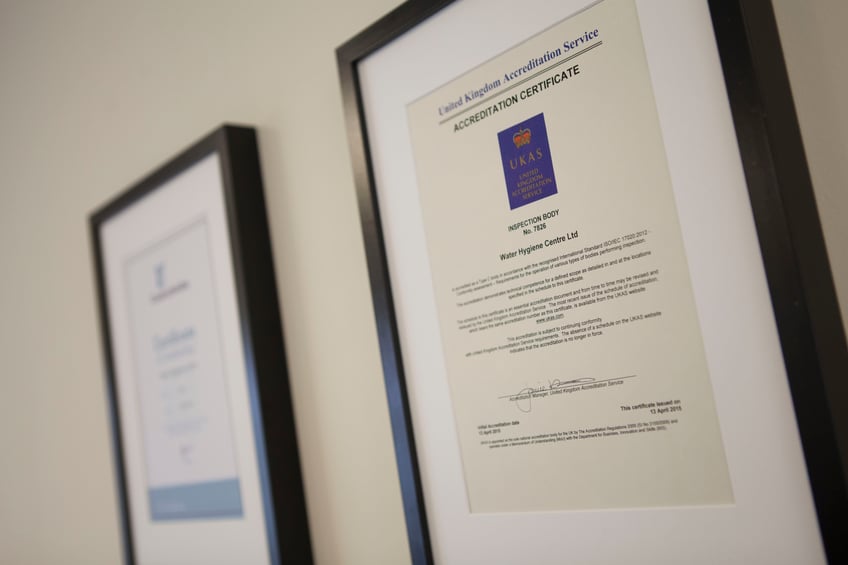
If we look to BS8580-1, where risk assessments are completed in accordance with this standard, then UKAS accreditation is an additional logical fit for the delivery of suitable risk assessments.
We already acknowledge UKAS accreditation for laboratories that complete analysis on water samples. The same is true with the calibration of thermometers! Therefore, accreditation to the UKAS ISO:17020 Conformity Assessment seems sensible too, an accreditation for organisations that perform various types of inspections, surveys, and risk assessments, and for the impartiality and consistency of their inspection activities.
As such, appointing a UKAS-accredited water hygiene company to complete your Legionella risk assessment can be critical in ensuring consistency and reducing the degree of 'guestimation' during the selection process, and ensures impartial advice and knowledge.
Currently, there are only a handful of companies listed by UKAS as being accredited for the delivery of ISO:17020 Conformity Assessments. The Water Hygiene Centre is one of them; this list can be found here: UKAS ISO:17020
Impartiality and Professionalism
A central principle of ISO:17020 accreditation includes ensuring impartiality. As such, a consultancy should not be the same entity that carries out any remedial works. For those of us who are drivers, remembering back to the dreaded driving test, the Driving Test Examiner was not your driving instructor!
So both integrity and impartiality will remain important. This segregation of duties (and any financial motivation) means a professional Legionella risk assessor will remain independent without vested interests in recommending additional/unnecessary actions.
In summary, the selection of a water safety consultancy can be somewhat overwhelming. However, knowledge of the ACOP L8 and BS8580-1 and ensuring a chosen water safety consultancy has accreditation to the LCA [for risk assessments], and preferably UKAS ISO:17020 will ensure the selection process and decision to appoint has exercised due diligence.
As a final note, the HTM04-01 also details that individual risk assessors demonstrate evidence of their training and recent experience either as part of a presentation or an interview!
Further reading> The Hidden Dangers in Hospital Water Systems
Feel free to reach out if you have any questions about this blog or if you would like to consult with one of our experts for further advice on water hygiene.
Editor's Note: The information provided in this blog is correct as of the date of original publication - July 2022 (Revised January 2026)
© Water Hygiene Centre 2026