

Decarbonisation and green energy measures can have a major effect on water safety in buildings. Although they reduce carbon emissions, they may also create serious unintended risks, including increased growth of Legionella and other opportunistic pathogens caused by system stagnation, lower water temperatures, and reduced disinfectant residuals.
Core Risks Factors
Lower operating temperatures:
Choosing heat pumps to be the primary heat source should be carefully managed if hot water at 60oC is to be achieved. The pasteurisation requirement should not be overlooked; thus 70oC should be achievable. Heat pump performance varies with ambient conditions, the building’s actual heat demand, operating temperatures, and with age, so to optimise the heat pump benefits may require supplementary plant and equipment.

Reducing hot water storage temperatures may appear to be a simple way to cut energy use, but it involves more than adjusting the hot water generator set point. Lower temperatures can allow water to fall within the ideal growth range for Legionella bacteria. ACoP L8 requires hot water to be stored at 60oC and delivered at 50oC at outlets, or 55oC in healthcare settings. Alternative control measures may be acceptable where a competent Legionella risk assessment or design review demonstrates that they are equivalent to, or better than, the ACoP L8 requirements.
Low-flow fixtures:
Retrofitting existing plumbing with water-saving fittings, such as aerators, low-flow showerheads and dual-flush cisterns, can reduce water use but may also cause pressure drops, flow imbalance and blockages in domestic water and drainage systems. Reduced flow rates lower water velocity and shear stress, allowing biofilms to develop and sediment to accumulate, which can increase maintenance requirements and affect system reliability.
Existing drainage systems are often sized for larger-volume cisterns, so replacing them with low-volume dual-flush units may provide insufficient water to clear waste effectively. This can lead to repeated flushing, which undermines the intended water savings.
Cold water storage:
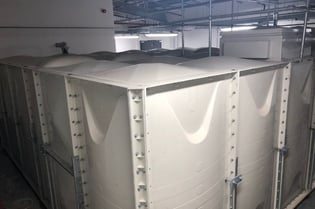 Storage calculations sometimes include allowances for future expansion, and tanks may be selected at the next size above the actual requirement, creating excess capacity. Adding low-flow fixtures to systems with oversized storage can further reduce turnover and increase the risk of stagnation.
Pipework distribution heat loss:
Thermal insulation on hot water pipework reduces heat loss but does not eliminate it; similarly, insulation only slows heat gain in cold-water pipes. Increasing insulation thickness can further reduce heat loss or gain, but congested service routes and limited access may make this impractical. As an alternative to a large centralised hot water system with extensive distribution pipework, low-volume point-of-use water heaters may be considered, subject to the operational needs of the facility.
Rainwater Harvesting and Greywater Systems
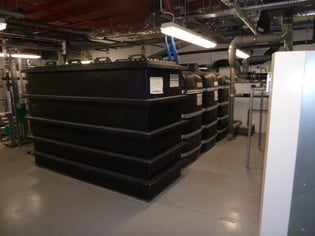 Buildings increasingly collect rainwater or recycle greywater (from sinks and showers) to flush toilets, irrigate landscapes and run cooling towers (subject to rigorous treatment and filtration). We do, however, need to look at the overall system and its detrimental impact, such as additional plant and equipment bringing Cap Ex / Op Ex, extra space to be constructed and ongoing maintenance that increases the carbon footprint.
EA/NHBC/Energy Saving Trust believes such systems have a 30% higher carbon footprint. We’re told that water-hungry data centres may increase demand for water. Some may have been installed with dry/wet cooling when they should have had evaporative cooling towers.
Cross-contamination is a severe hazard. If a physical cross-connection occurs between non-potable and potable water lines, pathogens or chemical contaminants can backflow into the drinking water supply. Furthermore, recycled water contains higher organic loads, accelerating bacterial multiplication if stored poorly; therefore, robust control strategies are required.
Solar Water Heating:
Solar thermal collectors absorb sunlight to pre-heat domestic hot water, reducing the load on secondary heating systems.
Solar energy is intermittent. On cloudy days or during periods of low building occupancy, large solar pre-heat tanks sit lukewarm. This creates a highly vulnerable "lukewarm zone" where bacteria can thrive. The key is to ensure that the fluid in the solar panels heats the main hot water store indirectly and typically has a separate means of heating to top up when required. Suitability for the UK climate should be assessed with the contrast of seasonal weather patterns.
Mitigation Strategies
In the modern built environment, changes that benefit one aspect e.g. net zero, can create risks elsewhere.
Water systems should continue to comply with the Water Supply (Water Fittings) Regulations 1999 and the Approved Code of Practice and Guidance L8, Legionnaires’ disease: The control of legionella bacteria in water systems.
Some mitigations are:
 Smart Monitoring: Implementing remote monitoring for water flow and temperatures reduces manual site visits while tracking stagnation in real time.
- Eco-Friendly Disinfection: Technologies such as copper-silver ionisation and Ultraviolet (UV) light are utilised to control biofilms and pathogens without relying on high temperatures or harsh chemical byproducts.
- Alternative Disinfection: Supplemental chemical water treatment, such as chlorine dioxide or copper-silver ionisation, can control bacterial growth at lower temperatures.
- Rigorous Filtration: Apply robust multi-stage filtration, UV disinfection, or disinfection to recycled water before storage.
- Strict Colour-Coding: Use distinctly marked, purple pipework or use copper pipe for domestic water and plastic for non-wholesome water for all non-potable water lines to prevent accidental cross-connections during maintenance.
- Air Gaps: Implement physical, non-mechanical air gaps (compliant with local water regulations) at all top-up connections between mains water and recycled water tanks.
- Automated Flushing: Install smart, sensor-activated flushing valves on low-use outlets to regularly purge stagnant water.
Conclusion
Before making changes to an existing water system, the overall impact should be risk assessed.
Responsible and competent persons within the organisation should validate and authorise any planned changes to ensure water safety is not compromised in pursuit of energy savings. Green certification schemes, such as BREEAM or LEED, require robust Water Safety Plans that balance efficiency targets with public health legislation; however, these targets should never be achieved at the expense of user safety.
Feel free to reach out if you have any questions about this blog or if you would like to consult with one of our experts for further advice on water hygiene.
Editor's Note: The information provided in this blog is correct as of the date of original publication – July 2026.
© Water Hygiene Centre 2026