

From factory to occupant use.
In Part 1, we looked at what happens to the water system before and during the module's journey to site. Part 2 addresses how you can ensure your water system is still safe and fit for purpose during and after installation.
For modular projects, you should consider the water system as having a continuous chain of water safety responsibility from design through to occupation.
The water system effectively passes through a number of stages:
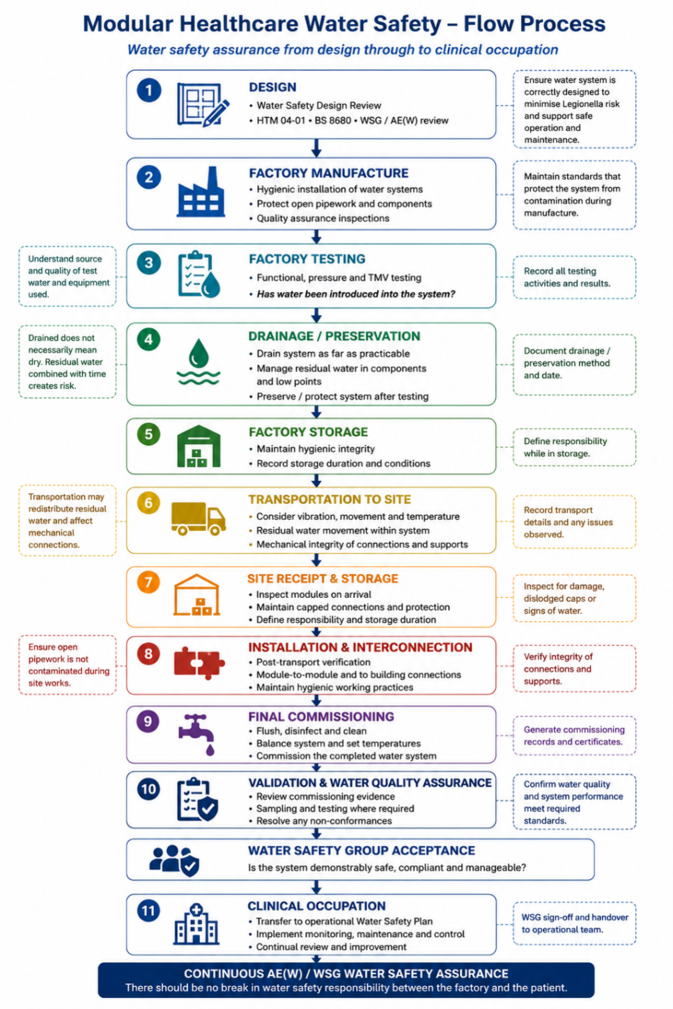
At each stage, somebody should be able to answer a simple question:
“Who is responsible for maintaining the hygienic integrity of the water system now?”
There should not be a gap where responsibility sits somewhere between the modular manufacturer, transport process, principal contractor, commissioning team and healthcare organisation.

What Are We Seeing Through Authorising Engineer (Water) (AEW) Reviews?
From experience of AE(W) audits and project reviews, many water safety problems encountered by operational estates teams can be traced back to decisions made much earlier in the project lifecycle; a recurring issue found is typically late engagement.
 The Water Safety Group or AE(W) may first see a design after significant decisions have already been made; in modular construction, this is particularly important because the design may already have progressed into manufacture.
There is also the issue of repeatability; standardisation is one of modular construction's greatest strengths, but from a water safety perspective it can also become a weakness due to some of the factors listed below:
- A poorly considered branch of distribution pipework
- Oversized pipe
- Inaccessible valves
- An unnecessary outlet is included within the standard module.
Another recurring concern is the gap between construction completion and operational readiness. A building can be physically complete but still not be ready for safe occupation from a water perspective, as it would need to go through commissioning, flushing, disinfection, microbiological verification, and Water Safety Group acceptance; all this needs sufficient time to take place. These activities should not be compressed or compromised simply because the construction programme has reached practical completion.
IHEEM, Modular Construction and Healthcare Engineering
The increasing discussion around modular construction within IHEEM and the wider healthcare engineering community is timely, as Modern Methods of Construction offer significant opportunities, but healthcare buildings are not simply construction projects; they contain complex engineering systems whose performance can directly influence patient and end-user safety.
The core healthcare engineering principles of competence, governance, maintainability, technical assurance and lifecycle management remain relevant, irrespective of whether a building is assembled on a hospital site or manufactured many miles away. From a water safety perspective, it is believed modular construction makes early technical assurance even more important. If manufacture is taking place remotely, water safety expertise needs to reach into that manufacturing process. The opportunity should be to use modular construction to standardise good practice, rather than simply standardising construction.
Why Water Safety Design Reviews Matter
 Within healthcare premises, HTM:04-01 Parts A & B place significant emphasis on the safe design, installation, commissioning and management of water systems, while BS8680:2020 reinforces the principles of proactive Water Safety Planning and risk management across the lifecycle of the water system. These principles do not begin at the site boundary; for modular construction, they need to extend back into the factory. A meaningful Water Safety Design Review / Legionella Risk Assessment should therefore consider not only pipe sizing, stagnation, temperatures and system configuration, but also:
- How the water system will be manufactured.
- How pipework will be protected from contamination.
- Whether factory testing will be wet or dry.
- How modules will be stored.
- How they will be transported.
- What post-transport inspections will be undertaken.
- How modules will be interconnected.
- How the completed system will be commissioned, disinfected and validated.
The above is why early engagement matters, as changing something on a drawing or prototype is relatively straightforward; however, discovering the same problem after it has been manufactured into dozens of modules is not.
Some Practical Considerations
From an AE(W) perspective, we would encourage project teams to consider several basic principles:
- Undertake the Water Safety Design Review before manufacture starts.
- Do not wait until modules begin arriving on site.
- Do not wait until modules begin arriving on site.
- Understand the factory process.
- The Water Safety Group and AE(W) should understand how water systems are installed, protected and tested within the manufacturing facility.
- The Water Safety Group and AE(W) should understand how water systems are installed, protected and tested within the manufacturing facility.
- Know when water first enters the system.
- Every wet test should form part of the system's water safety history.
- Every wet test should form part of the system's water safety history.
- Do not assume drained means dry.
- Consider residual water within components and low points.
- Consider residual water within components and low points.
- Include transportation within the assurance process.
- Consider both residual water movement and mechanical integrity following transport.
- Consider both residual water movement and mechanical integrity following transport.
- Maintain hygienic protection during site assembly.
- Factory standards need to continue through module-to-module connection.
- Factory standards need to continue through module-to-module connection.
- Commission the completed system.
- Factory testing provides valuable evidence, but it should not replace final commissioning and validation of the assembled water system.
- Factory testing provides valuable evidence, but it should not replace final commissioning and validation of the assembled water system.
- Maintain a clear record of responsibility from manufacture through to occupation.
A Final AE(W) View
Modular construction has the potential to provide significant benefits to a wide range of industries; however, from a water safety perspective, it also provides an opportunity.
If we engage early enough, standardised modular designs could allow good water safety principles to be reviewed once, challenged properly, and then consistently reproduced.
But the opposite is equally true. A design weakness that would traditionally have affected one installation can potentially be replicated across numerous modules before anyone identifies it, which is why Water Safety Design Reviews need to move to the design concept stages of the programme. We need to understand each stage and not simply accept what arrives at the site, but the complete history of the water system before it arrives.
- W
 here was it manufactured?
 - How was it protected?
- Has it contained water?
- What water was used?
- How was it drained?
- How long was it stored?
- What happened during transportation?
- Who was responsible at each stage?
Along with what evidence demonstrates its condition before it is connected to the water system? As the water system within a modular building does not begin its lifecycle when the module arrives at the site, its water safety journey begins in the factory.
As the New Hospital Programme and the wider NHS estate increasingly embrace Modern Methods of Construction, our water safety assurance processes must evolve with them. For modular healthcare buildings, water safety does not start when the building arrives at the hospital; its water safety journey begins in the factory.
Feel free to reach out if you have any questions about the issues mentioned above or if you would like to consult with one of our experts on water hygiene.
Editor’s Note: The information provided in this blog is correct at the date of original publication – September 2026.
© Water Hygiene Centre 2026